
0 items
Subtotal: 0,00 €

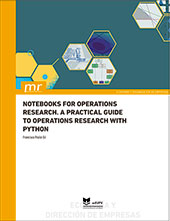
Notebooks for Operations Research: a practical guide to operations research with Python

Materia
Economía y Organización de Empresas
Idioma: Inglés
Colección: Manual de referencia
Formato: Archivo electrónico. PDF acceso libre. Color
Tamaño: 210 x 297 Nº Páginas:416
Nº Edición: 1  /   19-12-2024
ISBN:  978-84-1396-253-5 Ref.: 6778
DOI:  https://doi.org/10.4995/MR.2024.677801

Resumen

Notebooks for Operations Research is a practical guide that uses Python and Jupyter Notebooks to teach the principles and applications of operations research. Designed for both beginning students and professionals, the text connects theory and practice through interactive tutorials, solved exercises, and the use of Python libraries to solve problems with a hands-on approach. Chapters cover topics such as linear programming, combinatorial optimisation, non-linear programming, decision and game theory, simulation and Markov chains. Each section integrates mathematical concepts with real-world applications, demonstrating how to solve optimisation and decision-making problems in complex contexts, especially in supply chain management. In addition, the book highlights the relationship between operations research and artificial intelligence, focusing on mathematical reasoning and optimisation techniques, and provides an introduction to machine learning. It is an interactive book in the sense that all content is available in an interactive online environment that allows experimentation with the code. It provides fundamentals, tools and open source resources for those seeking to master operations research in a practical and modern approach.

Fraile Gil, Francisco

Holds a PhD in Telecommunications from the Polytechnic University of Valencia, with a background in research, innovation and teaching. He currently works at the Centre for Research in Production Management and Engineering (CIGIP), where he leads projects in digital platforms for manufacturing and logistics, integration of artificial intelligence and robotics, and zero defects manufacturing. He has coordinated and participated in R&D&I projects, in European, national and regional calls, standing out in the transfer of sustainable technologies to industry. Associate professor at EDEM, he is dedicated to training future engineers in operations research and programming. His work combines applied research and education in automated production systems engineering, pursuing a strong social and technological impact.
